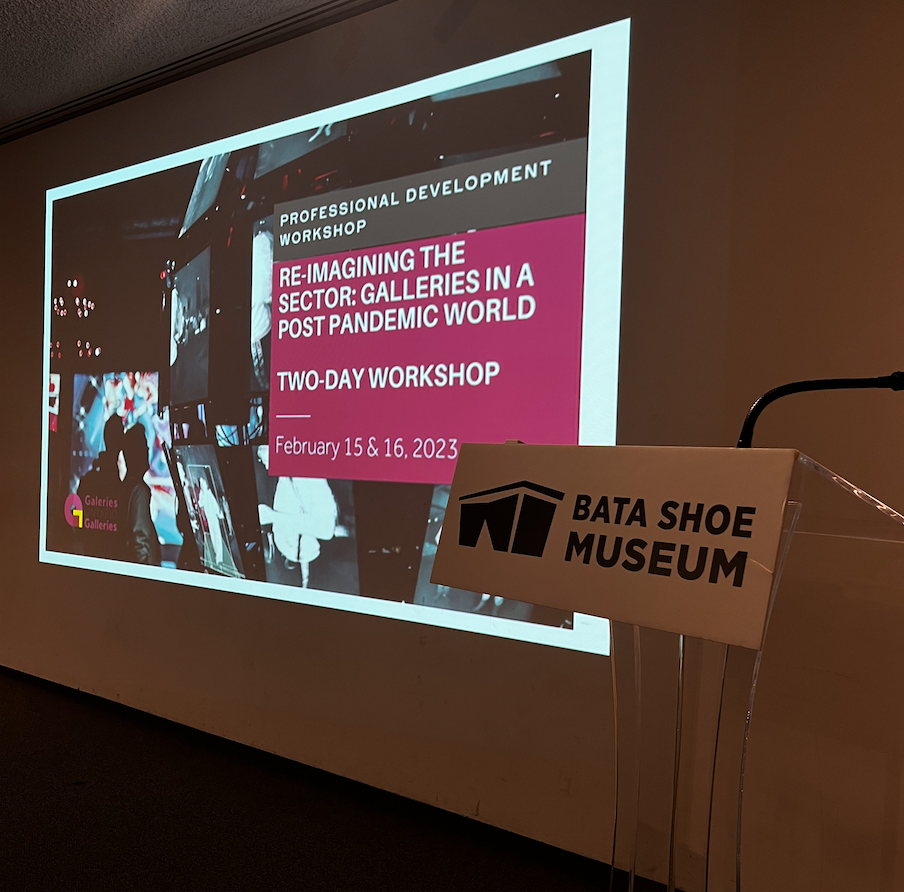
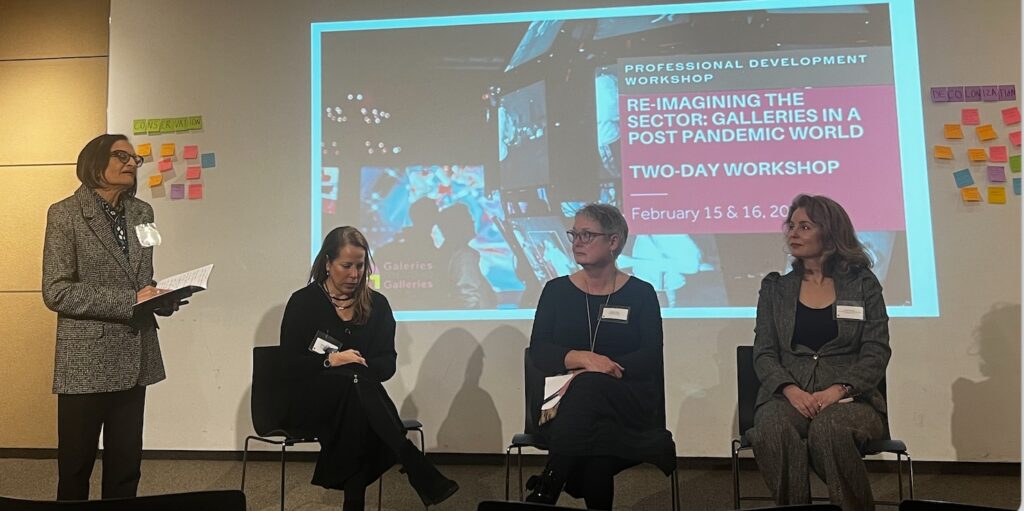
Galeries Ontario / Ontario Galleries’ hosted a two-day workshop on February 15 and 16, 2023, Re-Imagining the Sector: Galleries in a Post-Pandemic World, which focused on two key aspects: Working during Recovery and The Future of the Gallery.
Day one, Grounding in New Realities focused on renewal and the first steps galleries can take to start the long process of recovery. The day started with a conversation on Collections Management. We heard from Christine Saly-Chapman, Collections Manager at the Art Gallery of Burlington, she shared that digitizing their collections was the main priority as their museum hadn’t updated their digital collections since 2012. Due to this delay in digitizing their collections, they were unable to have online exhibitions while their gallery was closed. Christine then explained that the pandemic was actually an advantage point for the gallery, as they were able to take the time to photograph their permanent collection while the gallery was closed to the public. Contrasting to the second speaker of this session Suzanne Petersen, Collections Manager/ Registrar of the Bata Shoe Museum shared that the Bata had already digitized their collections and were able to have an online exhibition during the lockdowns. However, due to the pandemic, they were unable to return or obtain their own items that were on loan abroad, due to travel restrictions. Though these two galleries have varied experiences during the pandemic, a large theme of this session was digitizing collections and how to use your permanent collections to your advantage.
This theme carried into our next session, Re-engaging your Audience using your Collections. Nadja Pelkey, from Art Windsor-Essex (AWE) shared that their gallery started a program called Look Again! Outside . This program features life-sized reproductions of nine artworks from AWE’s collection installed throughout downtown Windsor. This enabled a relationship with their prime audience, the people of Windsor- Essex. This relationship sprouted new members and audience engagement which resulted in new faces in the gallery once it was able to re-open. Danuta Sierhuis from Agnes Etherington Art Centre also shared her galleries techniques to re-engage their audience during the pandemic. They launched Agnes from Home in March 2020; this allowed their audience to view over 1700 items in their digital collections, watch items in their digital archives as well as virtual tours of their exhibitions. The gallery also produced surveys to see what their audience members wanted to see. The easiest way to serve your audience is to ask them what they want. As a result of this, they produced a podcast series, “With Opened Mouths”, which gives artists, poets, performers, activists and curators a platform to speak about what motivates them to imagine new worlds. This appealed to a larger audience, who may be interested in different art forms. To re-engage your audience, you first have to have a connection with them and be an active player in the community you serve.
Being present in your community can be an asset when sourcing partnerships and collaborations. Natasha Downes, Executive Director of Station Gallery elaborated on this, saying that their primary partners are other organizations within their community of Whitby, Ontatio. Natasha explained that the gallery acts as a middle man, connecting one organization to another, which she says is “the best of both worlds”, as they can attract new audiences to their small gallery. Her advice to small to midsize galleries is to think outside of the box when sourcing partnerships and collaborations. One successful partner that Station Gallery works with is a local brewery. The gallery hosts free events such as beer or wine tasting for the brewery, which yields more traction to the gallery space and more donations. Following this success story, we heard from Allyson Adley from the Art Gallery of York University. Allyson explains that they started to partner with local artists from their community, Jane and Finch, Toronto. These are not just visual artists, but young Hip Hop, R&B and spoken word artists. The artists would “take over” their instagram live, which would notify the gallery followers but also the followers of the artists resulting in more engagement.
The last session of day one looked at how to support your staff during hard times. COVID-19 was classified as a disaster on the impact to society, the economy and how we interacted with each other, experiencing ‘collective trauma’. Therefore, we as a collective have become resilient to the impact of the pandemic. This resiliency can be fueled by a positive work environment with adequate policies such as mental health support, reward and recognition and flexible schedules and reasonable work expectations, explained by Mike Rudolph, Director of People at Heliolytics and arts supporter. Mike suggested to re-evaluate your organization’s HR policies, procedures and practices. A way to do this is to perform a SWOT analysis, which analyzes the Strength, Weakness, Opportunity and Threats, this will ensure that the policies and procedures are aligned with the strategic goals of the organization and meets the needs of the staff. We all want our organization to succeed and the only way that is possible is for our staff to succeed. Mike suggests a simple strategy: ask your staff how they are doing. This can be done through one on one meetings, anonymous team surveys, and internal scans. It is important to touch base with your employees as employers are legally responsible to create a healthy work environment.
Day two, The Future of the Gallery, focused on how galleries and museums will need to adapt in order to work through the impact of the pandemic in order to envision a different future. The day started with an interactive activity exploring the idea of the future of collecting. This activity was centered around four themes: Engagement, Digitization, Conservation and Decolonization. Participants were asked to place any ideas, concerns, or questions under these four headers and find the linkages as a group. The takeaway was that the future of collecting encompasses multiple priorities and intersections of an institution. These categories remained a theme throughout the day.
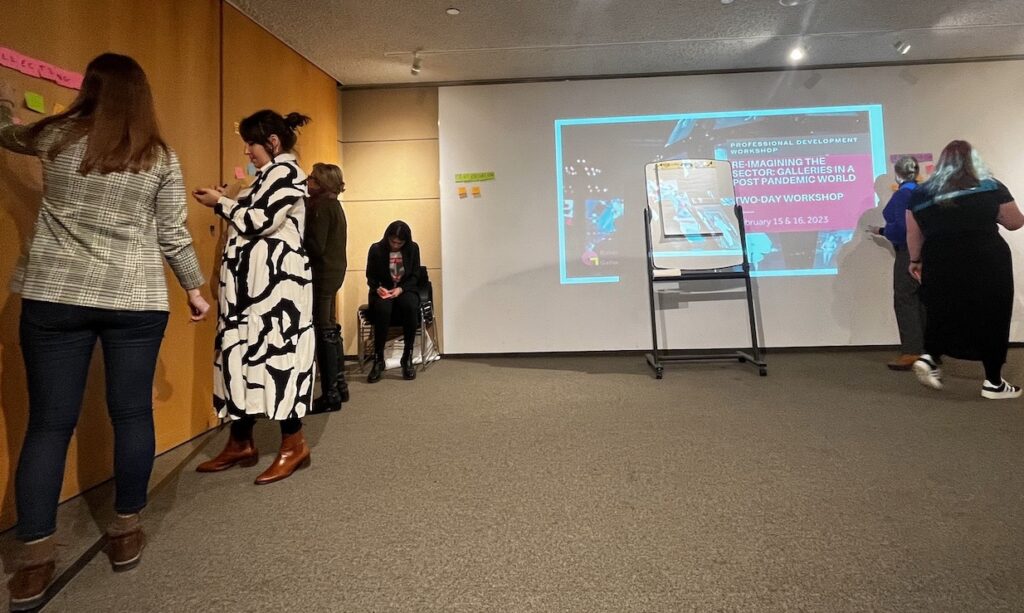
We simply cannot talk about the future of the gallery, without discussing the future of digital. Kelly Frances, Marketing and Communication Director of the Aga Khan Museum shared that we are in a digital age and digital divide, where online streaming platforms are our competitors. The pandemic highlighted the ‘digital divide’ amidst the visual art sector – those who could adapt and those who could not because of lack of training and resources in digital technologies. No matter the skill level, our outgoing content needs to be aligned with your mission for adequate audience engagement. To ensure this, digital engagement can be broken down into three main categories, social media, digital exhibition and online content. It is important that there is not one person in your organization that is dedicated to digital work, but that all staff should have some insight on digital strategies so that it can be carried across your organization.
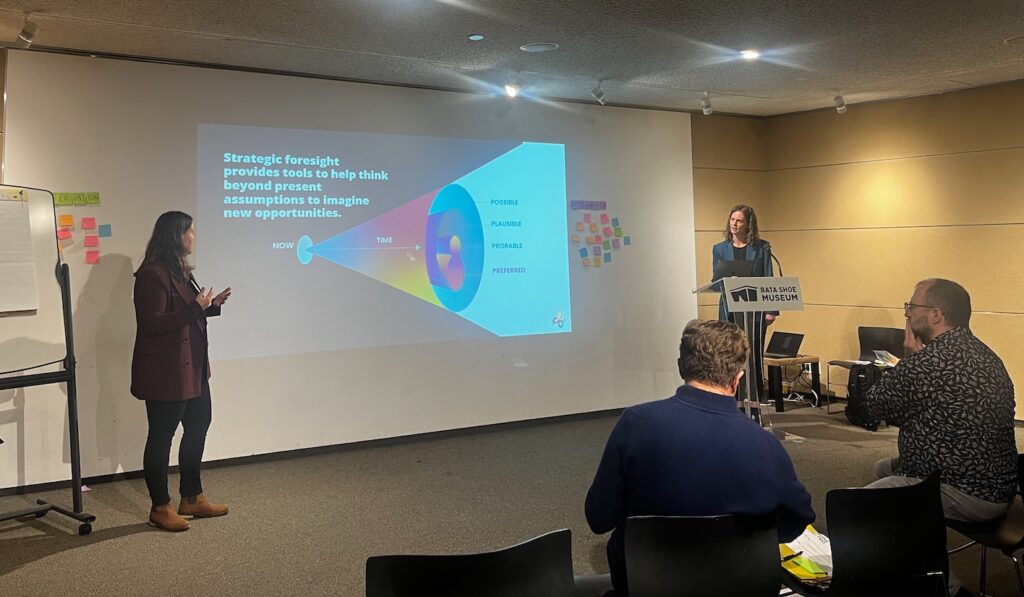
Peter Pavement, from Surface Impression further elaborated on this, saying that digital transformation is the act of adopting digital technology or digital thinking to transform an organization’s operation. He suggests investigating the idea of Futurology, the study of future possibilities, based on the analysis of current trends. These trends can help your organization to invest in certain technologies, such AR/VR or generative AI. Jessica Thornton and Heather Russek from Creative Futures explained that strategic foresight can help us gain confidence when looking to the future. Strategic foresight provides tools to help think beyond present assumptions to imagine new opportunities and is a method for anticipating potential futures and better preparing for inevitable change. These technologies may seem daunting and out of reach, depending on your organization, but Leah Resnick from Digital Museums Canada shared valuable resources to make this a reality. Leah reaffirmed that digital should be in all avenues of the organization and that it should be embedded in our processes, decision-making and forums. She shared that Digital Museums Canada offers an investment program meaning they do not only provide funds, but also expertise and support helping organizations build digital capacity.
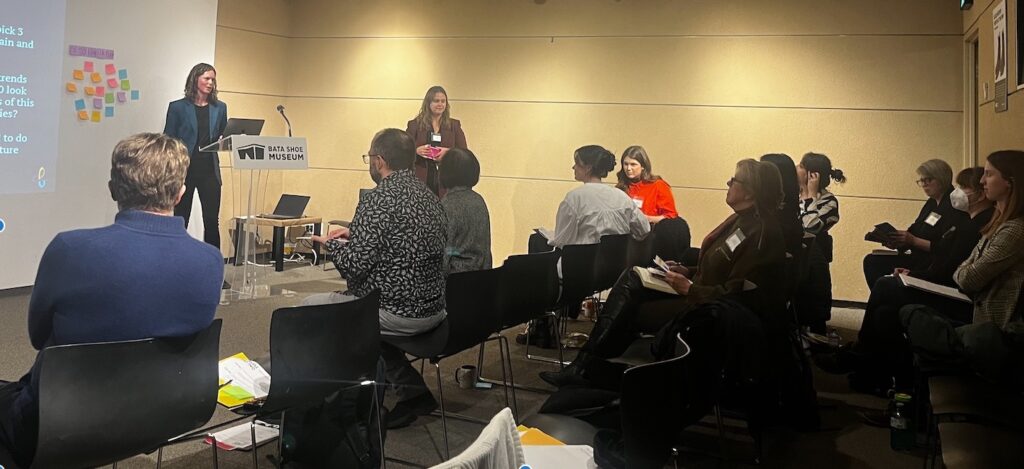
To close our two-day workshop, a panel discussion was had with cultural leaders from various organizations with differentiating missions and mandates. Zainub Verjee led the panel by incorporating the first session of day two, bringing up the themes of engagement and digitalization and what are we doing now for the future of the gallery. Shelley Falconer, President and CEO of the Art Gallery of Hamilton said that we need to “keep our foot on the gas pedal” when moving to digital, that digital engagement is key. However, we need to be nimble and flexible with new obstacles that may arise. Susan Taylor, Executive Director of Kawartha Art Gallery, also agreed that having a digital ecosystem will better serve their large community, though it is important to remember that galleries have a responsibility to protect their physical space and collections. Kelly Frances added that the most important thing for the future of the gallery is that galleries need to be welcoming to all, relevant and accessible.
Re-Imagining the Sector: Galleries in a Post-Pandemic World left participants with key important takeaways. Galleries have a responsibility for their collections and the people they serve. Therefore investing time to connect with your audience will be beneficial for the future of the institution. The staff within the gallery needs to be supported to succeed so that the gallery can succeed. A large theme of the workshop was digital engagement, this will target a larger audience and ensure relevance in the future. This workshop left us with the thought that galleries have a core responsibility, as a public institution and as a sector we must work together to ensure the relevance of the gallery is cemented in the community we serve.